
Emotional Fitness 101
I'm glad you're curious about emotional fitness. Let's discuss:
In the words of a client
Listen as an executive with a nationally-ranked charter school talks about his journey of becoming emotionally fit.
What is Emotional Fitness?
Emotional Fitness is the willingness to take full responsibility for your emotions, and the ability to identify, feel, and express a range of emotions authentically, without judgment or blame of oneself or others. This requires both humility to look inward and courage to feel.
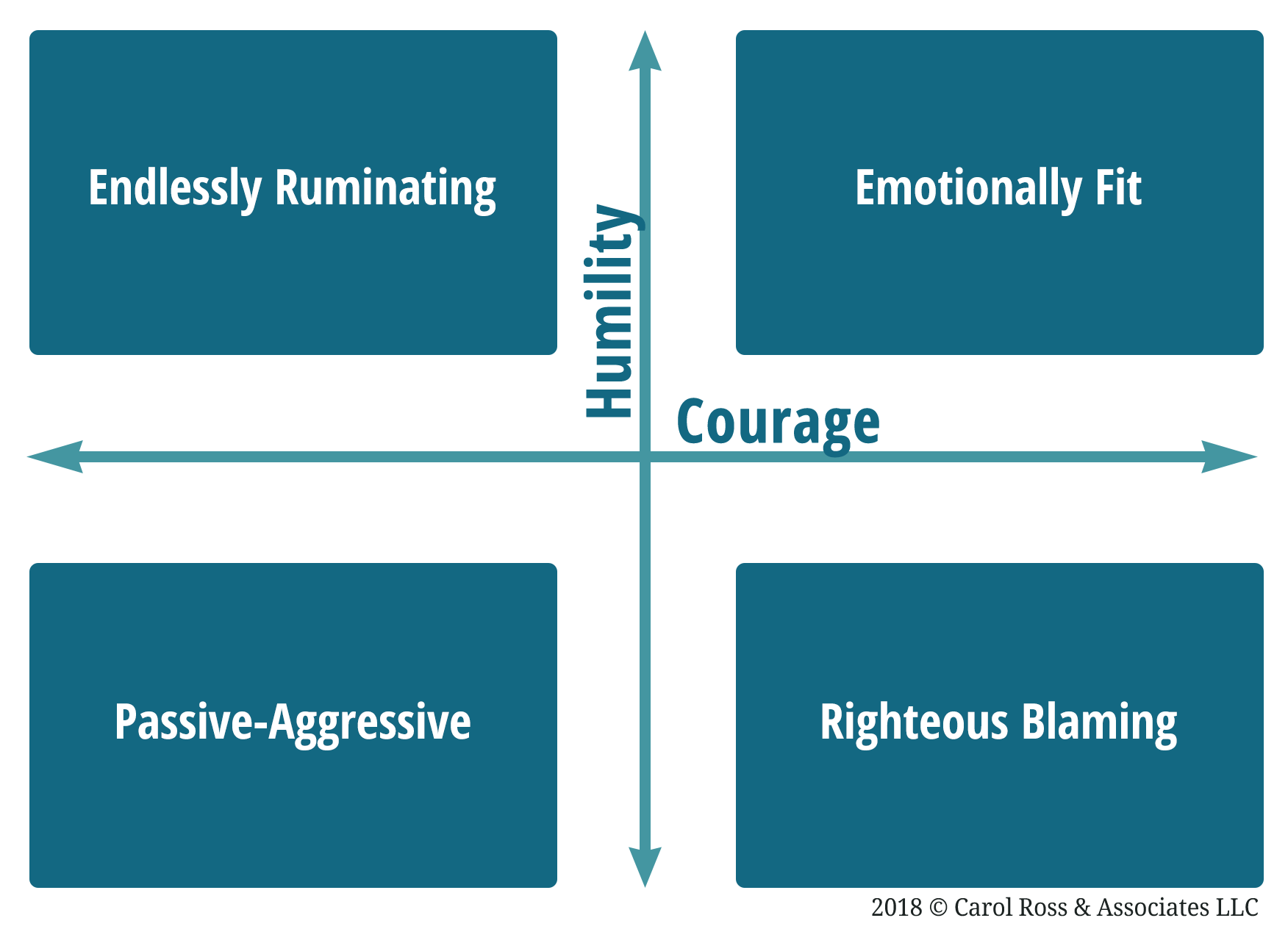
When leaders have the humility to look inward but lack the courage to feel, they fall into the trap of Endlessly Ruminating. They might be skilled at self-reflection, but it’s all head and no heart. Rather than feeling their feelings, they try to “figure it out” and end up endlessly ruminating. Instead of acknowledging their feelings, they attempt to side step their emotion.
Examples include:
• A guilt-ridden peer who justifies poor decisions with data overload
• A loquacious boss who needs to “talk out” every misstep, but never initiates change
• A direct report who shuts down emotionally in a performance review and just wants to know the steps to take to improve
When leaders lack both the humility to look inward and the courage to feel, they resort to Passive-Aggressive behavior. They armor up, fly under the radar, and opportunistically attack others.
Examples include:
• A manipulative colleague who decides it’s better to go it alone, rather than collaborate with others
• A micro-manager who believes that if you want to get it done right, you have to do it yourself
• A senior leader who makes an oblique, well-disguised criticism about the CEO on a conference call
When leaders are short on humility but have no problem feeling their emotions, they exhibit Righteous Blaming. They use the energy of emotions inappropriately and refuse to take responsibility.
Examples include:
• An executive who belittles and berates employees
• A star employee (e.g., technical guru, financial whiz) who no one wants to be around because he is “prickly”
• A rainmaker who creates drama with a client and then blames her assistant
When leaders have both the humility to look inward and the courage to feel, they are on the path to being Emotionally Fit.
Leaders who are Emotionally Fit have:
• A willingness to be vulnerable, to be open to and acknowledge feelings. They welcome all of their emotions as sources of wisdom and support. Feelings, even uncomfortable ones, are an internal GPS to navigate daily life.
• Awareness, both of the world around them and their inner world. They are present to the immediate moment and listen deeply to themselves and others.
• Ownership. They take responsibility for their impact, on themselves and others.
Creating a Positive Workplace Climate
Every workplace has an emotional climate.
Just like the weather, one day it could be “stormy” and another day it could be “sunny.”
Consider the following, from the classic book on emotions and leadership, Primal Leadership: Realizing the Power of Emotional Intelligence by Daniel Goleman, Richard Boyatzis, and Annie McKee:
- A positive climate (how people feel about their company) accounts for 20 to 30% of business performance.
- 50 to 70% of how employees perceive their organization’s climate can be traced to the conditions created by their leader.
- How well leaders manage their moods and affect everyone else’s moods is a factor in how well a business performs
Bottom line:
Workplace climate, business performance and a leader’s emotional fitness are intertwined.
Listen to client, Tim Wise as he discusses the ROI of Emotional Fitness.




Emotionally Fit Leaders have a positive impact on the emotional climate.
They create thriving workplaces.

They are calm, powerful and resilient
Emotionally Fit Leaders are calm, powerful, and resilient, even under stressful circumstances.
- They exude a sense of well-being.
- Instead of resorting to manipulation and control, they embody trust and hope.
- They make better decisions, in the moment and in the long term, in the face of uncertainty and ambiguity.

Willing to have the hard conversations
Emotionally Fit Leaders are willing to have the hard conversations that others avoid, creating more trust.
- They don’t walk past emotions when an issue arises, but rather acknowledge and work with emotion as a first step to addressing the issue.
- Knowing that emotions are present, they aren’t afraid to ask, “How did that make you feel?”

They are less likely to take things personally.
Emotionally Fit Leaders are less likely to take things personally.
- They step into the role of “observer” to see what’s happening with the larger system, rather than simply reacting to circumstances.
- Instead of being intimidated or fearful, colleagues feel comfortable giving feedback, which helps leaders grow.